
Rent vs. Buy Calculator: Which Is Actually Cheaper? Let’s Ditch the Guilt Trip
There’s a quiet, nagging voice that visits most of us around the first of the month. You open your banking app, see the rent payment clear, and that voice whispers: “You’re just throwing money away. You should be building equity. What are you waiting for?”
Maybe it’s your parents asking when you’ll finally “settle down.” Maybe it’s the endless Instagram reels of smiling couples holding oversized keys in front of beige houses. Or maybe it’s just the deep, cultural belief that renting is a failure and buying is success.
But here’s the uncomfortable truth that no one likes to talk about at dinner parties: Sometimes, renting is the smarter financial move. Not just “okay for now,” but genuinely, mathematically smarter.
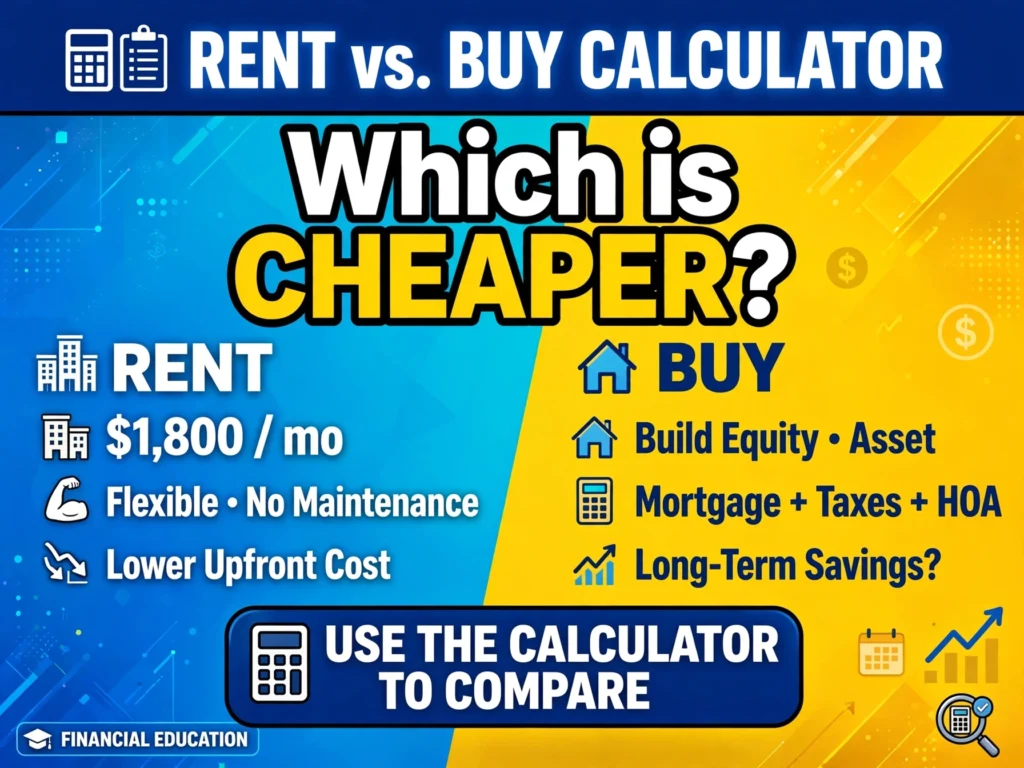
A Rent vs. Buy Calculator isn’t just a tool to compare two dollar amounts. It’s a tool to silence the guilt. It replaces societal pressure with hard, personalized data. But a calculator is only as honest as the human inputting the numbers. Let’s walk through the real costs—the ones banks forget to mention and Zillow conveniently hides—so you can make a decision based on your life, not your guilt.
Tearing Down the “Rent is Throwing Money Away” Myth
First, we need to dismantle the biggest lie in personal finance. When you pay rent, you are paying for a roof, sure. But you’re also paying for infinite flexibility and zero liability.
When you own a home, you don’t just have a mortgage. You have a financial vampire that drains your checking account in ways renters never see. To use a calculator correctly, you have to stop comparing “Rent” to “Mortgage.” You have to compare “Rent” to “The Black Hole of Ownership Costs.”
Let’s build the most realistic Rent vs. Buy calculator possible, starting with the hidden numbers.
The Hidden Side of Buying: The Costs the Listing Price Hides
When you look at a mortgage calculator and it says $2,200 per month, your brain automatically compares it to your $2,200 rent and thinks, “Wow, same price! I should buy!”
Slow down. That $2,200 is the tip of the iceberg. We need to calculate the “True Monthly Cost of Owning.” Write these down.
1. The Principal & Interest (The Obvious One)
This is your actual loan payment. Easy.
- Amount: $_______
2. Property Taxes (The Silent Budget Killer)
Taxes aren’t fixed. They rise. And depending on your state, they can be more than your car payment. Take the annual tax bill and divide by 12.
- Monthly Tax Estimate: $_______
3. Homeowners Insurance (Lender’s Requirement)
It’s pricier than renters insurance by a long shot.
- Monthly Insurance: $_______
4. Private Mortgage Insurance (The Penalty)
If you don’t have 20% down, you’re paying PMI. This is money you burn protecting the bank, not you. This can be $100 to $400 a month.
- Monthly PMI: $_______
5. The Maintenance Fund (The “Oh No” Budget)
Here is the rule of thumb that homeownership veterans know: Budget 1% of your home’s value per year for maintenance. A $400,000 house? That’s $4,000 a year, or roughly $333 a month.
- Maintenance Set-Aside: $_______
Now, add those five lines up. That number? That’s your real monthly housing cost.
**Total True Ownership Cost: $_______
If that number is significantly higher than your rent, don’t panic. This doesn’t mean you shouldn’t buy. It just means we need to look at the wealth-building side of the equation.
The Hidden Side of Renting: It’s Not a Black Hole
Now, let’s be fair to renting. The common argument is, “With a mortgage, you’re building equity.” This is true. But the sneaky counter-argument is the “Opportunity Cost” of your down payment.
When you buy a house, you sink a massive pile of cash into the front door. Let’s say $60,000. That money is now trapped in your walls. You can’t eat your drywall.
If you rent, that $60,000 stays in your brokerage account or index fund, quietly compounding at the historical stock market average (around 7-10% long-term).
- Your Down Payment: $_______
- If Invested at 7% for 10 Years: It could potentially double.
The Rent vs. Buy calculator needs to factor this in. Are you going to come out ahead because your house appreciated in value? Or because you invested the difference and stayed liquid? In many high-cost cities, renting and investing the leftover cash beats buying hands down over a 10-year period.
The “Life Season” Calculator: The 5-Year Rule
Forget the interest rates for a second. The single most important factor in the Rent vs. Buy equation isn’t money. It’s time. Specifically, “How long are you staying?”
The transaction costs of buying a home are brutal. You pay closing costs to get in (roughly 2-5% of the purchase price). Then, when you sell, you pay real estate agent commissions (usually 5-6%). It takes years of appreciation just to break even on the fees, let alone make a profit.
This is where our humanized calculator becomes crystal clear.
Scenario A: The 3-Year Hustler
You’re young, mobile, and your career might move you across the country in 30 months. If you buy right now, the closing costs alone will likely wipe out any equity you build.
- Verdict: Rent. The fees to buy and sell will eat your lunch. This is a mathematical near-certainty.
Scenario B: The 7-Year Settler
You’ve found the neighborhood. You know the coffee shop owner’s name. You’re not going anywhere for a decade.
- Verdict: Buying is heavily favored. You have time to ride out market dips and spread those closing costs over thousands of days.
Putting It All Together: The “Feelings” Checklist
A calculator spits out a graph, usually showing that buying wins after Year 5. But a graph doesn’t capture the human anxiety of the “Hot Water Heater Tuesday.”
On a random Tuesday night, if your water heater explodes and floods the basement, who do you call?
- Renter: You call the landlord. Annoying? Yes. Expensive? No.
- Owner: You call your bank account. You’re looking at a $1,500 emergency you didn’t plan for.
This isn’t a reason to avoid buying, but it’s a reason to buy for the right reasons. Don’t buy a house because your uncle told you you’re wasting money. Buy a house because you are psychologically and financially ready to be the CEO, plumber, and landscaper of your own life.
The Final Calculation: Which is Cheaper for a Human?
There is a quiet dignity in renting. You are buying time. You’re buying the ability to walk away, to move for a dream job, and to sleep without scanning the house for weird smells.
There is a deep security in owning. You’re buying autonomy. No one is raising your rent 20% just because they feel like it. You can paint the walls neon green if you want.
Here is your take-home calculator, no internet required:
- The Math Test: Take the “True Ownership Cost” (Mortgage + Taxes + Insurance + PMI + 1% Maintenance) and subtract the “Equity Build” (the tiny bit of principal you pay down in the early years).
- Compare it to Rent: Is the number left over higher or lower than your rent?
- Apply the 5-Year Filter: If you leave before Year 5, the fees likely ruin the math. Rent.
- The Sleep Test: Which option makes you breathe easier when you turn the lights off at night?
Don’t let society bully you into a mortgage you don’t want yet. Don’t let fear keep you from a home you’re ready to love. The “cheaper” option isn’t the one with the lower monthly auto-draft. It’s the one that creates the most stability and joy for the season of life you’re in right now.