
Mastering Your Money: A Practical Monthly Expense Tracker & Budget Template Guide
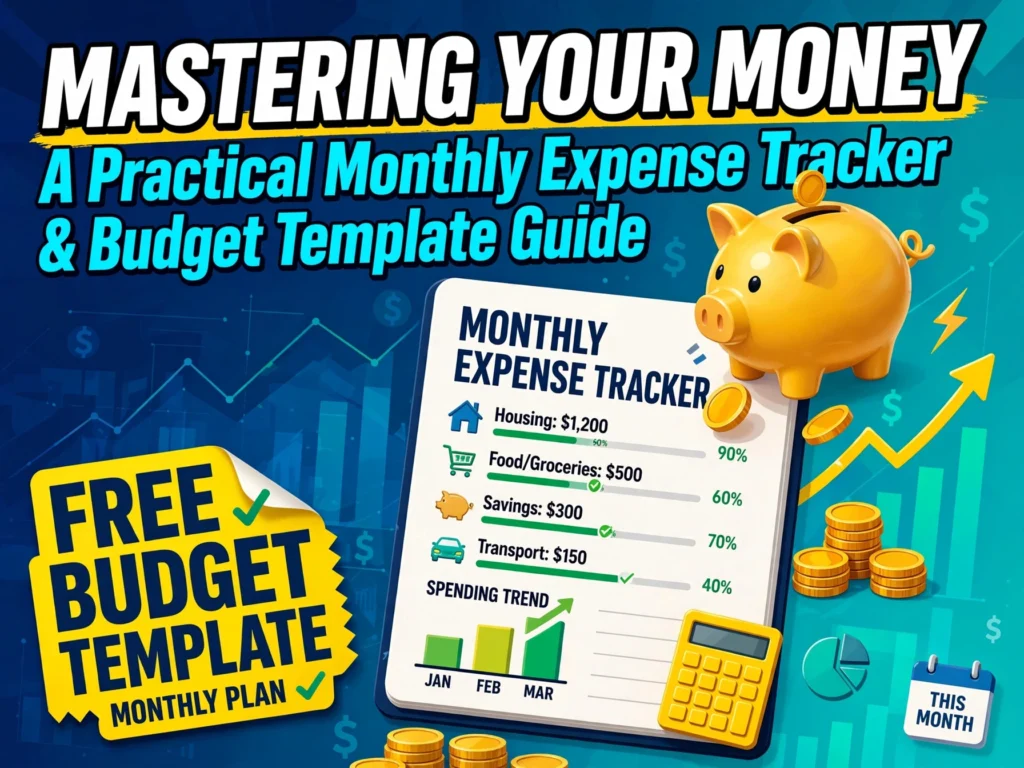
How a Simple Tracking System Can Bring Clarity, Control, and Confidence to Your Financial Life
The Real Reason Your Money Feels Out of Control
Most people believe the solution to financial stress is earning more. But the truth, often discovered too late, is that awareness matters more than income. You can earn a comfortable salary and still reach the end of each month wondering where everything went. That quiet, gnawing feeling of uncertainty doesn’t come from a lack of resources. It comes from a lack of visibility.
A monthly expense tracker and budget template solves this problem not by restricting your life, but by illuminating it. Think of these tools as a flashlight in a dark room. The room was always there. The furniture was always there. The money was always there. But without light, you stumble. With light, you walk confidently. This guide will show you how to build and use a monthly expense tracker that fits your actual life, along with a budget template that adapts to your changing needs. No shame. No guilt. Just clarity.
Why Mental Tracking Fails and What a Monthly Expense Tracker Does Differently
The human brain is a remarkable organ, capable of incredible feats of memory and calculation. Yet it consistently fails at tracking daily expenses with any accuracy. This is not a personal failing. It is simply how our minds work. We remember the large, emotionally significant transactions—the rent payment, the car repair bill, the insurance premium. But the small, routine purchases fade from memory almost instantly. The morning coffee. The streaming subscription that renews quietly. The quick lunch pickup between meetings.
Individually, these amounts feel too small to matter. Collectively, across a thirty-day cycle, they often represent hundreds of dollars that simply vanish from awareness. This is what makes a monthly budget tracker so transformative. It serves as an external memory system, capturing every transaction without judgment and without the gaps that mental accounting inevitably creates. When you write down where your money goes, you stop guessing and start knowing. That shift, from vague estimation to documented reality, is the foundation upon which all financial progress is built.
An expense tracker doesn’t demand perfection. It demands consistency. A simple notebook, a spreadsheet, or a dedicated app can all serve the purpose. What matters is that the tracking happens daily or near-daily, preventing the end-of-month scramble through bank statements that never quite captures the full picture. The goal is a single source of truth about your spending, replacing anxiety with actionable information.
Designing Your Budget Template: A Structure That Supports Real Life
A budget template is not a prison. It is a framework that holds your financial intentions in place while allowing flexibility for the unexpected. The most effective templates share a common structure: they organize expenses into logical groups that reflect how you actually spend, rather than how an idealized version of you might spend.
The foundation of any budget template begins with fixed obligations. Housing costs occupy this space—rent or mortgage payments, property taxes, and insurance premiums. Transportation follows closely, covering vehicle payments, fuel or public transit costs, and maintenance allocations. These categories represent commitments that remain relatively stable from one month to the next, providing the anchor points around which variable spending can flex.
Variable necessities form the next layer of the template. Food expenses deserve particular attention and careful separation. Groceries purchased for home preparation should occupy one line, while restaurant meals, takeout orders, and delivery services occupy another. Combining these into a single food category obscures the behavioral patterns that drive overspending. When your monthly expense tracker reveals that restaurant spending rivals grocery spending, you have discovered a leverage point for meaningful change. Utilities, healthcare costs, and household supplies also belong in this category—necessary but subject to adjustment through conscious choices.
The final layer of a well-designed budget template addresses lifestyle and discretionary spending. Subscription services represent a uniquely modern challenge. Streaming platforms, software licenses, cloud storage plans, gym memberships, and digital publications each carry small individual costs that compound into significant monthly drains. A dedicated subscription section within your expense tracker brings these recurring charges into full visibility. Entertainment, clothing, personal care, gifts, and a deliberately limited miscellaneous category round out the template structure.
Critically, savings must appear as a fixed line item, not an afterthought. When a budget template treats savings as whatever remains after spending, savings typically remains at zero. Positioning savings alongside housing and transportation—as a non-negotiable allocation—transforms it from optional to essential. Even a modest amount, consistently set aside, builds momentum that grows over time.
Choosing Your Expense Tracker Medium: Digital, Paper, or Both
The medium you select for your monthly expense tracker matters less than your willingness to use it consistently. However, each option carries distinct advantages worth considering before committing to a particular approach.
Spreadsheet-based tracking, particularly using cloud platforms that synchronize across devices, offers unmatched customization. You can build formulas that automatically calculate category totals, compare actual spending against your budget template projections, and generate visual charts that reveal patterns over time. The manual entry requirement, while initially appearing burdensome, creates a deliberate interaction with each transaction. Every logged expense represents a moment of conscious acknowledgment, strengthening the mental connection between spending and awareness that automated systems cannot replicate.
Dedicated budgeting applications provide convenience through automatic transaction import and categorization. These tools reduce the daily friction of tracking, making them suitable for individuals who would otherwise abandon the practice entirely. Many apps can connect directly to bank accounts, pulling transaction data and sorting it according to customizable rules. However, automation introduces a subtle but significant risk. The ease of passive tracking can diminish active engagement with your financial reality. Notifications can be dismissed, and the app itself can fade from daily consciousness. The most successful app users treat the technology as a supplement to regular manual review, not a replacement for it.
Paper-based tracking, including printed budget templates and dedicated notebooks, offers psychological benefits often overlooked in digital-first discussions. The physical act of writing expenses by hand engages neural pathways differently than typing, creating stronger memory encoding around financial decisions. A visible tracker placed in a consistent location—on a desk, refrigerator, or nightstand—serves as a persistent environmental cue that keeps financial awareness active throughout the month. There is no notification to distract you, no app to switch away from, just the deliberate practice of recording and reflecting.
The optimal choice depends entirely on your natural tendencies. The expense tracker that aligns with your personality and routines will outlast the technically superior option that conflicts with how you actually live.
Building the Habit: How to Use Your Monthly Budget Tracker Consistently
The implementation phase determines whether a tracking system thrives or collapses. Most abandoned efforts share a common root cause: attempting to simultaneously document spending and dramatically reduce it. This dual focus creates unsustainable psychological pressure that leads to system rejection.
A more effective approach separates the measurement phase from the modification phase. During the initial thirty-day period of using your monthly expense tracker, focus solely on accurate documentation. Spend as you normally would. Make no judgments. Record every transaction honestly, without shame or editing. This baseline month generates essential intelligence about your current patterns without the confounding variable of willpower-dependent restriction. You are functioning as a neutral observer, collecting data that will inform future decisions rather than passing moral judgment on past behavior.
Daily consistency matters more than daily perfection. A sixty-second evening routine—checking bank transactions, logging any cash purchases, categorizing each entry—maintains the tracking habit without imposing significant time burdens. This brief practice, attached to an existing habit like brushing teeth or winding down for sleep, captures the day’s financial activity while it remains fresh in memory. It also prevents the end-of-month scramble that produces incomplete records and undermines the reliability of your budget template.
Category integrity requires honest self-reporting, and this is where many expense trackers lose their diagnostic value. Ambiguous transactions demand careful handling. A single receipt from a large retailer might contain groceries, household supplies, and a clothing item. Your monthly budget tracker should reflect this reality by splitting the transaction into its component categories. Assigning the entire amount to the most convenient label inflates certain spending lines while hiding others. The tracker works only to the extent that the data entered reflects truth rather than convenience.
Incorporating flexibility into your budget template prevents the discouragement that arises when rigid plans meet variable reality. December is not July. Holiday months carry gift expenses. Summer months might include travel costs or higher utility bills. Back-to-school season brings supply purchases. A professionally designed expense tracker accommodates these seasonal rhythms through adjustable allocations or buffer categories, acknowledging that financial life is inherently cyclical rather than perfectly uniform.
From Raw Data to Financial Intelligence: Analyzing Your Expense Tracker
A completed month of tracking produces data. But data alone does not change behavior. The transformation occurs during the review process that converts raw numbers into actionable insights. A monthly expense tracker earns its value not during the recording phase, but during the reflection phase that follows.
Begin your review by examining category totals against realistic expectations. Compare your actual spending not against some idealized minimalist budget, but against the baseline you established during your first tracking month. This approach acknowledges current reality while identifying incremental improvement opportunities. A food spending total that exceeds expectations by ten percent raises different questions than one that exceeds expectations by fifty percent, and the appropriate strategic responses differ accordingly.
Pattern identification yields insights that aggregate numbers conceal. A manageable monthly lunch expense within your budget template might reveal upon closer inspection that seventy percent of the total concentrates within the final two weeks of the month. This suggests a meal preparation fatigue phenomenon—you start strong and gradually default to convenience. Recognizing this pattern allows you to design targeted interventions, such as batch meal preparation timed for mid-month, rather than issuing vague resolutions to “eat out less.”
The subscription audit deserves particular emphasis as a recurring practice within your expense tracker routine. Automatic renewal mechanisms have normalized the accumulation of recurring charges that would never survive conscious monthly reconsideration. A quarterly review of subscription line items frequently identifies services that no longer justify their cost. Streaming platforms you stopped watching, apps you downloaded for a specific project and forgot, memberships that seemed essential during the sign-up offer period—these hidden drains compound dramatically over time. Eliminating unused subscriptions generates savings without requiring any lifestyle adjustment whatsoever.
Goal integration represents the final essential component of meaningful analysis. Abstract tracking, disconnected from personal objectives, eventually loses motivational power. Connecting your budget template to specific, visualized goals—perhaps a vacation photograph attached to the savings line, or a debt-elimination date calculated from accelerated payment tracking—provides the emotional fuel that sustains long-term adherence. Your expense tracker ceases to be a chore and becomes the instrument through which tangible desires are systematically achieved.
Common Obstacles and How to Navigate Them
Every person who adopts a monthly expense tracker encounters challenges. Anticipating these obstacles allows for proactive strategy development rather than reactive abandonment.
Inconsistency typically emerges when the initial enthusiasm of the tracking habit fades after the first two weeks. The remedy involves temporarily reducing complexity. If daily logging across twenty categories feels overwhelming, consolidate to five broad categories and rebuild consistency before attempting greater granularity. A sporadically maintained detailed expense tracker provides less value than a consistently maintained simple one. Consistency trumps complexity every time.
Discouragement arises when spending totals trigger shame that leads to avoidance. The remedy requires reframing the purpose of your budget template from judgment to information. The numbers describe behavior. They do not define character or worth. Approaching the data with clinical curiosity rather than moral evaluation preserves engagement through difficult revelations. Remember that every dollar figure in your tracker represents a choice you can adjust going forward, not a permanent verdict on your financial capability.
Perfectionism manifests when a single missed day or miscategorized transaction prompts abandonment of the entire monthly budget tracker. The remedy emphasizes progress over perfection. A tracker with eighty percent accuracy provides dramatically more value than no tracker at all. Missed entries can be estimated and noted for future correction. Categories can be adjusted retroactively when errors are discovered. The system serves you; you do not serve the system.
Complexity develops when an initially simple budget template accumulates excessive categories, subcategories, and conditional rules until the tracking process becomes burdensome. The remedy involves periodic simplification reviews. Consolidate categories that fail to provide differentiated insights. Eliminate tracking elements that no longer serve the original clarity objective. A streamlined expense tracker that you actually use outperforms an elaborate one that you avoid.
The Professional Category Structure for Your Budget Template
A thoughtfully organized monthly expense tracker transforms scattered financial data into coherent intelligence. The following framework represents a balanced approach to categorization that captures meaningful distinctions without becoming unwieldy.
The housing and utilities category encompasses shelter costs including mortgage or rent payments, property taxes, homeowners or renters insurance, electricity, natural gas, water, sewer, trash collection, internet service, and home maintenance allocations. This grouping captures the complete cost of maintaining your living situation.
Transportation costs cover vehicle loan or lease payments, fuel purchases, public transit fares, rideshare expenses, auto insurance premiums, registration fees, scheduled maintenance, parking, and tolls. This comprehensive category reveals the true cost of mobility.
Food and dining maintains the critical distinction between grocery purchases for home preparation and all external food acquisition including restaurant meals, takeout, delivery services, coffee shops, and vending purchases. This separation within your expense tracker illuminates the convenience premium being paid and facilitates targeted adjustments.
Health and wellness includes insurance premiums, medical copays, prescription medications, dental and vision care, therapy costs, and fitness memberships. Personal care items such as haircuts and hygiene products also belong here.
Lifestyle and discretionary spending captures the broadest range of variable expenses. Streaming subscriptions, digital services, software licenses, and cloud storage represent the digital component. Clothing, home furnishings, electronics, books, and hobby supplies form the physical goods segment. Entertainment, gifts, charitable donations, and a limited miscellaneous buffer complete the category.
Financial obligations track debt payments beyond housing and transportation, including credit card payments, student loan installments, and personal loan obligations. Insurance products not captured elsewhere reside here as well.
Savings and investments occupy the final category, positioned prominently within your budget template as a fixed obligation rather than a discretionary allocation. Emergency fund contributions, retirement deposits, general savings transfers, and investment purchases all belong in this essential grouping.
Integrating Your Expense Tracker Into Daily Life
A monthly expense tracker operates most effectively when woven into existing routines rather than imposed as a separate obligation. The goal is integration, not addition.
Attach your daily logging practice to an existing habit. While coffee brews in the morning, review yesterday’s transactions. While brushing teeth at night, record the day’s spending. This pairing leverages established neural pathways to support the new behavior, dramatically increasing the likelihood of long-term adherence. Your expense tracker becomes part of the rhythm of your day rather than a task that requires separate motivation.
Conduct monthly review sessions on a consistent date, scheduled in advance and protected from interruption. The first Sunday of each month. The day after payday. Whatever anchor makes sense in your calendar. These sessions examine category performance against your budget template projections, assess progress toward stated goals, identify emerging spending patterns, and adjust allocations for the upcoming month. The review transforms passive tracking into active financial management.
Annual analysis provides the longer perspective necessary for major decisions. Year-over-year comparisons within your expense tracker reveal inflation impacts, lifestyle inflation patterns, and genuine progress toward long-term objectives. This accumulated data supports informed choices about housing changes, vehicle replacements, and career transitions that isolated monthly reports cannot adequately inform.
Conclusion: From Tracking to Financial Freedom
Financial clarity is a form of personal power that no external circumstance can diminish. The individual who understands exactly where resources flow each month possesses the ability to redirect those resources toward any future they envision. A monthly expense tracker and budget template, properly designed and consistently maintained, provide this understanding.
The journey from financial fog to clarity begins with a single documented transaction. It continues through the establishment of sustainable habits, the honest confrontation with spending patterns, and the gradual realignment of outflows with genuine priorities. The tracker itself remains a humble tool—a spreadsheet, a notebook, an app—but the awareness it cultivates transforms financial life from reactive anxiety into proactive confidence.
A budget template does not restrict freedom. It creates the conditions in which genuine freedom can flourish. When every dollar has a purpose, and every purpose reflects a consciously chosen value, spending becomes an expression of intention rather than impulse. That is the ultimate promise of expense tracking: not restriction, but liberation.
Begin today. Open a blank spreadsheet or take out a sheet of paper. Write your monthly income at the top. List your fixed obligations. Estimate your variable expenses honestly. For the next seven days, record every transaction in the appropriate category. At week’s end, examine the gap between your estimates and your reality. This simple practice, repeated and refined, builds the foundation upon which lasting financial clarity is constructed. Your monthly expense tracker is waiting. The only remaining step is to begin.