The Silent Thief: How Inflation is Quietly Stealing From Your Savings Account
The Money Under Your Mattress is Shrinking
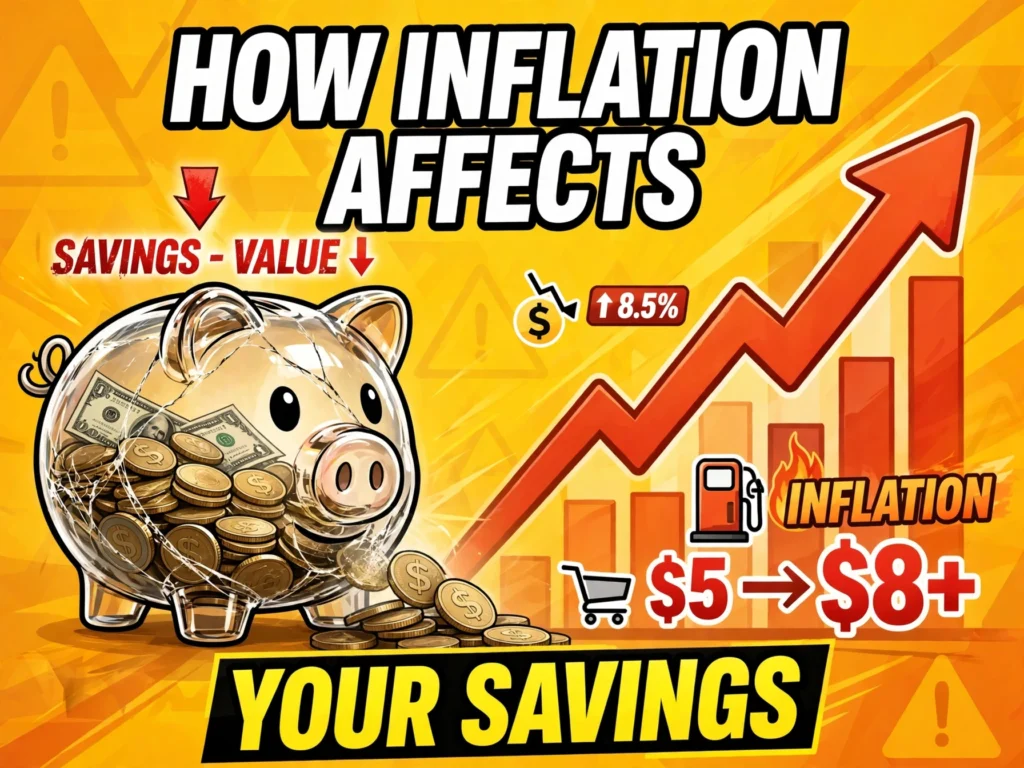
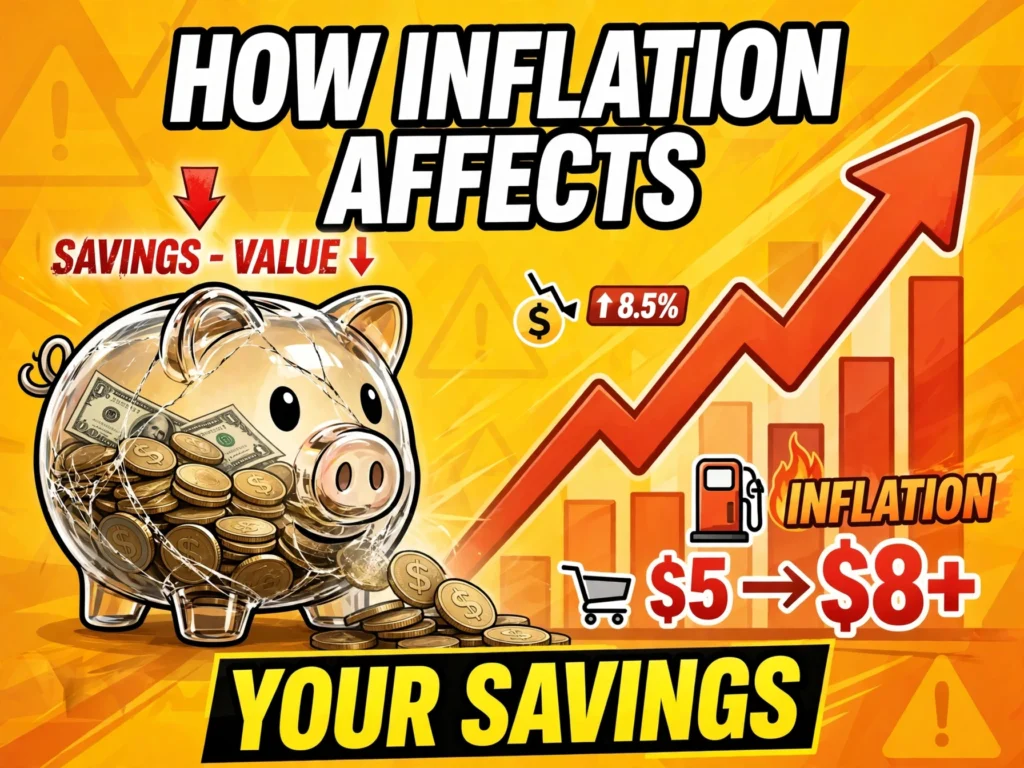
Have you ever opened your savings account statement and felt a sense of calm? That number is steady. It doesn’t go down like a risky stock portfolio. It just sits there, safe and secure. But what if I told you that while you’re sleeping, a silent thief is creeping into that account every single night, peeling off a little bit of value? That thief isn’t a hacker or a hidden bank fee. It’s inflation.
We often treat inflation like abstract financial news—something politicians and economists argue about. But the truth is, inflation is deeply personal. It determines whether your dream of retiring early is realistic, or if you can afford to help your kids with college. This post isn’t about confusing charts or Wall Street jargon. This is a human conversation about what inflation actually means for the money you’ve worked so hard to save, and how to fight back.
Table of Contents
1. The Banana Bread Principle: Why Your Dollar Today Isn’t the Same Tomorrow
1.1. The Grocery Store Time Machine
1.2. Defining Inflation Without the Textbook Jargon
1.3. The Magic Trick Where Money Disappears
2. The “Safe” Trap: Why Your Savings Account is a Losing Bet
2.1. The 0.01% Lie (Earning Interest But Losing Wealth)
2.2. Real-Life Math: How $10,000 Decays in 10 Years
2.3. The “Sleep at Night” Factor vs. The “Wake Up Broke” Factor
3. The Emotional Toll: How Inflation Changes Your Behavior
3.1. The Psychology of Shrinking Goals
3.2. “Why Bother Saving?”—Combating Financial Nihilism
3.3. The Stress of Moving Goalposts (Down Payments and College Funds)
4. Who Gets Hit the Hardest? (Spoiler: It’s Not the Rich)
4.1. The Retiree on a Fixed Income
4.2. The Young Professional with Cash Hoarding Syndrome
4.3. The Emergency Fund Paradox
5. Beating the Silent Thief: A Human Strategy, Not a Get-Rich-Quick Scheme
5.1. Tiers of Safety: The Water Bucket Analogy
5.2. The “Ladder” That Lets You Sleep at Night
5.3. Real Assets: Why a Can of Beans Can Outperform a Dollar Bill
5.4. The Only Formula You Need: Real Return = Nominal Return – Inflation
6. Conclusion: Don’t Just Save Money. Store Value.
6.1. Changing Your Relationship with Cash
6.2. The Bottom Line (Without the Sugarcoating)
1. The Banana Bread Principle: Why Your Dollar Today Isn’t the Same Tomorrow
Let’s start with a story.
1.1. The Grocery Store Time Machine
In 2019, I walked into a grocery store with a $20 bill. I could buy a bag of flour, sugar, eggs, butter, bananas, and chocolate chips. I’d go home, bake two loaves of banana bread, and still have change left over for a coffee. Last week, I walked into the same store with the same $20 bill. I bought the ingredients for the banana bread and got no change back. The coffee was out of the budget.
Did the bananas turn into gold? Did the flour become a luxury item? No. The value of my $20 bill simply melted. This is the grocery store time machine. It’s the simplest way to see that a dollar is not a measuring stick that stays the same length; it’s a shrinking ruler.
1.2. Defining Inflation Without the Textbook Jargon
Forget the Consumer Price Index (CPI) reports for a second. Inflation simply means that the supply of money is growing faster than the supply of things you actually want to buy. When there’s too much money chasing too few goods, prices go up. It’s not that things are getting more valuable; it’s that the cash in your pocket is getting weaker.
1.3. The Magic Trick Where Money Disappears
Think of your savings like an ice cube on a warm counter. You can watch it, protect it, and lock it in a safe, but if the room temperature (the economy) is hot, that ice cube is going to shrink. You aren’t losing physical dollar bills, but you are losing the energy those bills contain. That’s the sting of inflation—loss without visible theft.
2. The “Safe” Trap: Why Your Savings Account is a Losing Bet
We are taught from childhood that saving is a virtue. “Put it in the bank,” our parents said. But what if the bank has become a very expensive storage locker?
2.1. The 0.01% Lie (Earning Interest But Losing Wealth)
You look at your bank statement and see the “Interest Paid” line. Maybe it’s 30 cents. That’s the bank’s way of saying, “Thank you for storing your money here so we can lend it out.” But let’s look behind the curtain. If inflation is running at 3%, 4%, or even 7%, and your savings account pays 0.01%, you are locking in a loss of purchasing power every single year. You are paying the bank for the privilege of losing money.
**2.2. Real-Life Math: How $10,000 Decays in 10 Years**
Let’s do the scary math without a calculator. Imagine you have $10,000 perfectly safe in a vault. No risk. No volatility.
If inflation averages just 3% a year (which is historically “normal”), in 10 years, your $10,000 will only buy you what $7,440 would buy you today.
If inflation is at 7%, that $10,000 decimates to roughly $5,000 of buying power in a decade. Half of your life energy, vanished. The number on the screen still says $10,000, but the grocery store disagrees.
2.3. The “Sleep at Night” Factor vs. The “Wake Up Broke” Factor
We hold cash because we want “peace of mind.” We want to avoid the volatility of the stock market so we can sleep at night. But there is a different kind of fear—the fear of waking up at 65 and realizing the money you’ve been guarding with your life can no longer pay the rent. This is the trade-off. Sleeping well for 30 years only to face a nightmare at the end isn’t a good strategy.
3. The Emotional Toll: How Inflation Changes Your Behavior
This isn’t just a math problem. It’s a human experience problem.
3.1. The Psychology of Shrinking Goals
You set a goal to save a $40,000 down payment for a house. By the time you hit that number, the houses you were looking at have gone up by 20%. Now you need $48,000. It feels like running on a treadmill where the speed keeps increasing. It breaks your spirit. It makes you feel like the system is rigged, and honestly, in many ways, it is.
3.2. “Why Bother Saving?”—Combating Financial Nihilism
When the math doesn’t work, the human brain does a dangerous thing: it gives up. “If I can’t get ahead,” we think, “I might as well enjoy the money now.” We see this with the rise of “doom spending.” Inflation creates a culture of immediacy. Why save for a retirement that’s 30 years away if the money will be worthless? This is a survival instinct, but it’s a trap.
3.3. The Stress of Moving Goalposts (Down Payments and College Funds)
I spoke to a young father recently who started a college fund for his newborn daughter. He did the projection calculator, factoring in tuition inflation. The number was so astronomically high that he nearly closed the laptop and stopped contributing. This is the emotional toll. It preys on our fear of the future, making long-term commitments feel futile.
4. Who Gets Hit the Hardest? (Spoiler: It’s Not the Rich)
Rich people rarely hold cash. They own factories, land, and brands. When the value of the dollar drops, the price of their factory (in dollars) goes up. They are hedged. Inflation is a regressive tax that explodes the wealth gap.
4.1. The Retiree on a Fixed Income
Imagine you’re 70 years old. You can’t go back to work. You have a pension or annuity that pays the same amount every month. Last year, that covered your rent, food, and medication. This year, rent went up, food spiked, and suddenly, you’re choosing between heating and eating. Inflation steals dignity from our elders because they lack the time horizon to “earn their way out” of the hole.
4.2. The Young Professional with Cash Hoarding Syndrome
You see this often in the FIRE (Financial Independence, Retire Early) community. Young, high earners saving 50% of their income. But if they hoard it all in a checking account because they are “waiting for a crash,” inflation ensures they are running a race with a parachute tied to their back. You can be a fantastic saver but a terrible wealth-preserver.
4.3. The Emergency Fund Paradox
We need an emergency fund. Life happens. Cars break. But if you have a 6-month safety net in cash, and inflation spikes, that safety net thins out. Suddenly, it’s only a 4-month safety net in terms of actual buying power. The lesson here isn’t “don’t have an emergency fund,” but rather, “manage it wisely,” which we’ll talk about next.
5. Beating the Silent Thief: A Human Strategy, Not a Get-Rich-Quick Scheme
I’m not going to tell you to gamble on crypto or day-trade penny stocks to beat inflation. That’s trading one thief for a bandit. Here’s how a sane person protects their life’s work.
5.1. Tiers of Safety: The Water Bucket Analogy
Imagine your money as water in the desert.
- Bucket 1 (Drinking Water): This is your immediate cash for rent and next week’s bills. Keep it in checking, ignore the inflation loss because you need it liquid.
- Bucket 2 (The Camp Water Tank): This is your emergency fund. Don’t let it rot in a zero-interest account. Put it in a High-Yield Savings Account (HYSA) or a money market fund. You might not beat inflation fully here, but you’re slowing the bleeding.
- Bucket 3 (The River): This is the money you don’t need for 2-5+ years. It must flow into assets that have historically outrun inflation.
5.2. The “Ladder” That Lets You Sleep at Night
If you’re terrified of losing money in stocks, look at Treasury Inflation-Protected Securities (TIPS) or I-Bonds. These are boring, government-backed tools that adjust your principal based on inflation. The strategy here is called “laddering.” You buy a bond that matures in one year, one in two years, and so on. You’re building a wall against the invisible thief, guaranteed.
5.3. Real Assets: Why a Can of Beans Can Outperform a Dollar Bill
Value resides in scarcity and utility. Stocks (equity in real companies) are great inflation hedges because companies like Coca-Cola or Procter & Gamble simply raise the price of their products when inflation hits and pass the cost to the consumer. Real estate works similarly. Rent goes up with inflation. You don’t need to be a genius; you just need to own things that people can’t print.
5.4. The Only Formula You Need: Real Return = Nominal Return – Inflation
If your bank pays you 0.5%, and inflation is 4%, your “Real Return” is -3.5%. You are losing.
If a boring bond fund pays you 5%, and inflation is 3%, your Real Return is +2%. You are winning.
Stop focusing on the “risk” of the stock market going down for a month. Start focusing on the certainty of cash losing value forever. That’s the mindset shift.
6. Conclusion: Don’t Just Save Money. Store Value.
6.1. Changing Your Relationship with Cash
Cash is not a store of value; it’s a medium of exchange. You use it to buy groceries today, not to fund your retirement in 30 years. Once you stop viewing dollar bills as “safe” and start viewing them as “melting ice cubes,” your financial decisions become clearer. It’s not about getting rich; it’s about staying whole.
6.2. The Bottom Line (Without the Sugarcoating)
Inflation is the punishment for sitting still. It rewards those who participate in the economy by owning productive assets, and it punishes those who simply bury their talents in the ground out of fear.
Don’t let the silent thief make a fool out of you. You worked too hard for those hours, those late nights, and those missed vacations. Honor that sacrifice by deploying your money with intention. Acknowledge the problem, adjust the buckets, and ensure that the banana bread you want to bake in 2030 doesn’t cost you a $100 bill.
Call to Action:
Take a look at your bank statement right now. Not the balance—the interest rate. If it’s under 3%, you’re currently losing the war. Open a browser tab, search for “high-yield savings account rates,” and spend ten minutes giving your savings a fighting chance. That’s your homework. Your future self will thank you for it.