
FHA vs. Conventional Loan Calculator: Stop Guessing, Let’s Find Your Real Path to Homeownership
You’ve been scrolling through Zillow at 11 p.m., saving dream homes to your favorites folder. You’ve mentally arranged furniture in living rooms you don’t own yet. And now, you’re ready to get serious about the mortgage part.
Then the alphabet soup hits you. FHA. Conventional. PMI. MIP. DTI.
Suddenly, what felt like an exciting step toward adult life feels like a pop quiz you didn’t study for. Your cousin swears by FHA because it’s “easier.” Your dad says conventional is the “only smart choice.” A random Facebook commenter insists you should just pay cash. (Thanks, very helpful.)
Here’s the truth no one says out loud: neither loan is “better.” One loan is better for you. And finding that answer isn’t about loyalty to a brand—it’s about running your personal numbers through an honest mental calculator. One that accounts for your credit score, your savings account balance, and your actual plans for the next decade.
So let’s build that calculator together. No jargon. No sales pitch. Just a clear, human conversation about which path gets you the keys to that front door.
First, Let’s Clear Up the Real Difference (In Plain English)
Before we plug in numbers, you need to understand what you’re actually comparing. Most explanations make this sound like a boring textbook. It’s actually simple.
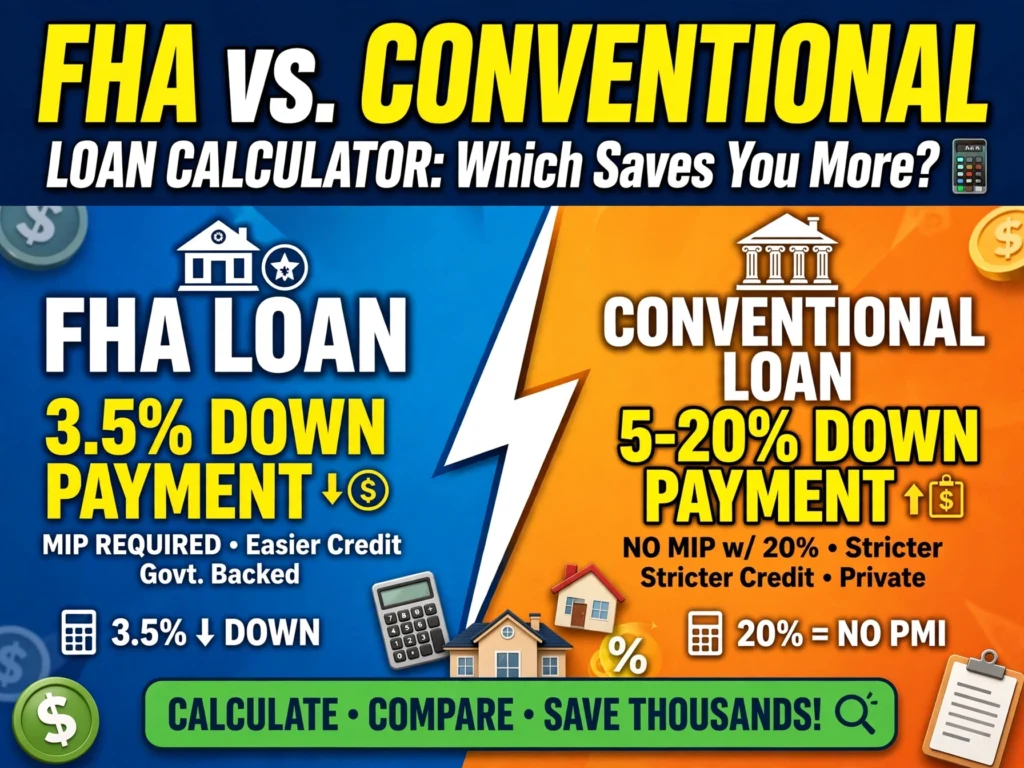
The FHA Loan: The “Open Door” Option
Think of FHA as the friend who gives you a chance when your track record isn’t perfect. Backed by the Federal Housing Administration, this loan was designed to help people who might not qualify for a traditional bank loan. The door swings open wider for lower credit scores and smaller down payments. But—and this is a crucial but—FHA asks for something in return. It charges you an insurance premium that sticks around for a long, long time.
The Conventional Loan: The “Prove It” Option
Think of conventional as the friend who says, “Show me you’re financially solid, and I’ll give you the VIP treatment.” Not backed by the government, these loans reward you with better terms if you have good credit and some money saved. The insurance (called PMI) isn’t permanent, and the fees can be lower. But the velvet rope is harder to get past.
The Human Calculator: Four Inputs That Actually Decide Your Loan
A bank plugs your data into software and spits out a “yes” or “no.” We’re going to plug your life into four questions and find out which path feels right. Grab your last pay stub and a rough idea of your credit score. Let’s go.
Input 1: The Credit Score Reality Check
This is the gatekeeper. Be honest with yourself here—no judgment, just data.
- If your score is below 620: Conventional is largely off the table. You’re looking at FHA, and that’s perfectly okay. FHA can go as low as 580 with just 3.5% down, and sometimes even lower if you have more money to put down. This isn’t a failure; it’s using the tool designed for your situation.
- If your score is between 620 and 700: You’re in the “twilight zone.” Both doors are open. Conventional lenders will talk to you, but they might charge you a higher interest rate or a more expensive PMI because they see you as a moderate risk. FHA will happily take you and might offer a lower base rate, but remember—FHA has its own insurance price tag. You absolutely must calculate both side-by-side here.
- If your score is above 720: Conventional starts looking very, very attractive. You’ll qualify for the best rates and the cheapest private mortgage insurance. FHA’s government insurance fee suddenly looks expensive in comparison. Conventional is probably your winner, but let’s keep going to make sure.
Input 2: The Down Payment Reality (Not Instagram, But Your Actual Bank Account)
Ignore the 20% down myth for a moment. Most first-time buyers don’t put 20% down. Here’s how your savings stack up.
- You have 3% to 5% saved: Both options are alive. FHA wants 3.5% minimum. Conventional now has programs (like Fannie Mae HomeReady or Freddie Mac Home Possible) that only ask for 3% down. Don’t assume FHA is the only low-down-payment game in town.
- You have less than 3%: You’re likely looking at FHA, or you might need to explore down payment assistance programs. USDA or VA loans could also be options if you qualify, but that’s a different conversation.
- You have 10% or more: Conventional is screaming your name. With a bigger down payment, your PMI gets even cheaper, and you start building serious equity from day one. FHA insurance starts to look like an unnecessary expense at this level.
Input 3: The “Mortgage Insurance” Showdown (The Silent Wealth Killer)
This is the most misunderstood, most expensive part of the entire decision. Both loans charge you insurance if you put less than 20% down. But they are wildly different animals.
FHA Insurance (MIP) is the stage-five clinger.
It has two parts: an upfront fee (1.75% of the loan amount, usually rolled into the balance) and an annual fee you pay monthly. Here is the brutal truth about FHA insurance today: If you put down less than 10%, you pay that monthly insurance for the entire life of the loan. Let that sink in. Thirty years. Even after you have 50% equity, you’re still paying it. The only way out is to refinance into a conventional loan later, which is possible but not guaranteed if rates go up.
Conventional Insurance (PMI) is the respectful guest who leaves.
You pay a monthly fee based on your credit score and down payment. But here’s the beauty: once your loan balance drops to 78% of the home’s original value, or you prove you’ve reached 20% equity, the PMI falls off. It cancels. You stop paying it forever, without refinancing. That could free up $100 to $300 a month in your pocket down the road.
The Calculator Question: Will you have the cash or home appreciation to reach 20% equity within a few years? If yes, conventional PMI is a temporary nuisance. If no, FHA’s permanent insurance might actually be cheaper on a monthly basis in the short term, but you pay it far longer.
Input 4: The “This Old House” Factor
This is where the Zillow photos matter more than your credit score. The property itself can choose your loan for you.
- Is the house a fixer-upper? FHA has strict “Minimum Property Standards.” Peeling paint, broken railings, or a roof that’s seen better days can kill an FHA deal instantly. The appraiser isn’t just valuing the home; they’re inspecting it for safety. A seller with a “loved but not updated” house might roll their eyes at an FHA offer.
- Conventional loans are more forgiving on cosmetic issues. If the bones are good, the lender is usually happy. This makes your offer more competitive if the house needs a little TLC.
- Are you buying a condo? FHA has an entire approved condo list. If the complex isn’t on it, you can’t get an FHA loan there. Period. Conventional is often the easier route for condo purchases.
The Emotional Inputs (Because Money Is Never Just Math)
We’ve talked numbers. Now let’s talk feelings. These matter more than any spreadsheet can show.
The “Skin in the Game” Question
How much cash will you have left after closing? If draining your savings to 3.5% down for FHA leaves you with $47 in your checking account, you’re one flat tire away from a financial crisis. A conventional 3% down program might leave you more breathing room, or vice versa. A “house poor” buyer can’t enjoy their new home. Your leftover cash cushion is a non-negotiable part of this calculator.
The “Forever Home” vs. “Starter Home” Question
Be brutally honest. Is this the house where you’ll raise kids and retire? Or is it a five-year pit stop?
- Five-year plan (Starter Home): FHA can be brilliant here. The lower upfront barrier to entry gets you in the door fast, you build a little equity, and you sell before the lifetime insurance cost really punishes you.
- Ten-plus-year plan (Long Haul): Conventional is likely the better long-term wealth builder. The insurance drops off, and the total cost over a decade is almost always lower, assuming your credit is decent.
Let’s Build the Final Verdict
Here is your human-powered calculator summary. Read through these profiles and see which one feels familiar.
You should lean toward FHA if:
- Your credit score is below 660, and you can’t wait to buy while you repair it.
- You need the absolute lowest possible out-of-pocket cost to get into a home.
- You’re buying a starter home and plan to refinance or sell within 5-7 years.
- You’ve accepted that the mortgage insurance is the cost of getting your foot in the door right now, and you’re at peace with that.
You should lean toward Conventional if:
- Your credit score is 700 or above. Don’t pay FHA’s premium pricing for no reason.
- You have 5% or more to put down, and still want a few months of expenses in the bank afterward.
- You’re buying a “rough around the edges” property or a condo.
- You want to eventually eliminate mortgage insurance without the hassle and cost of a full refinance.
- You plan to stay in this home for a decade or more and want the cheapest lifetime cost.
One Last Piece of Advice (From a Human, Not a Bank)
Do not let an online calculator make the final call for you. Use this framework we just built to walk into a lender’s office with confidence. Tell them: “I want to see quotes for both an FHA and a conventional loan, side by side. Show me the closing costs, the monthly payment, and the APR.”
Make them do the work. Look at the two pieces of paper. One of them will feel like a heavy chain around your ankle for years. The other will feel like a manageable stepping stone. Pick the stepping stone.
Your dream home shouldn’t start with a nightmare loan. You now know exactly what to ask for.
Ready to see the numbers for yourself? Drop your questions in the comments below, or share this with a friend who’s stuck in the same mortgage confusion. We’ve all been there.