
A Human Guide to Pre-Tax Deductions: Stop Overpaying and Start Understanding Your Paycheck
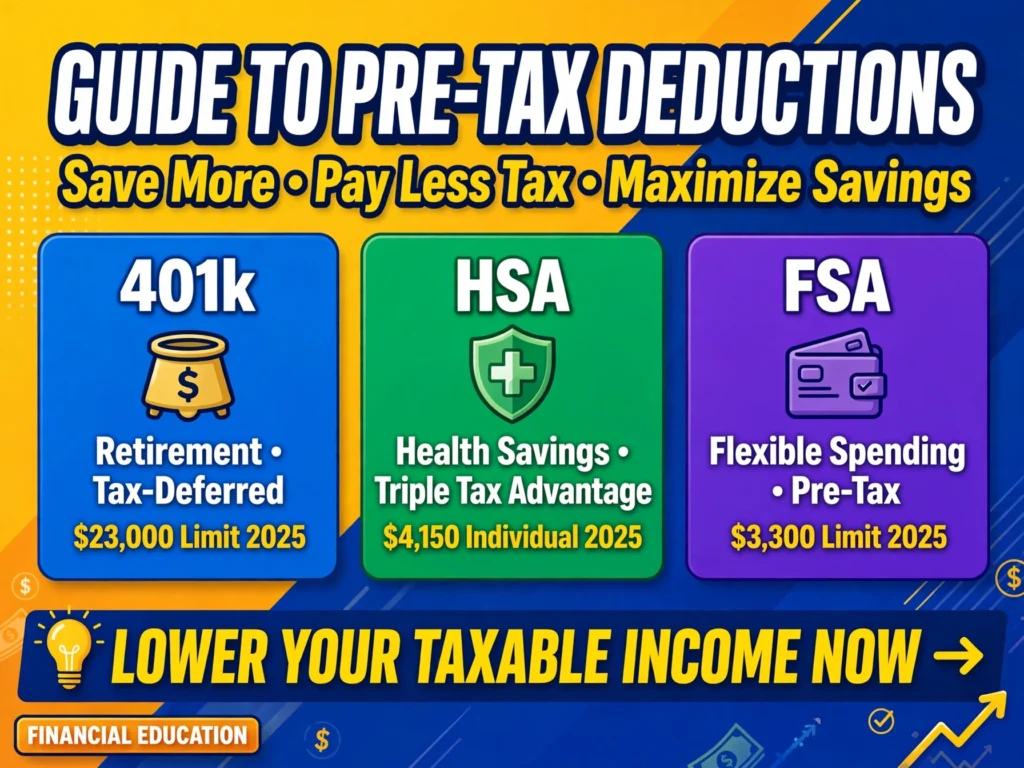
Raise your hand if you’ve ever looked at your paycheck and felt a tiny bit confused—or maybe even a little cheated.
There it is, right at the top: your salary. It looks great. It makes you feel like a responsible, capable adult. Then your eyes drift down the page. Gross pay. Net pay. Deductions. Acronyms. Suddenly, the number that hits your bank account looks a lot smaller, and you’re left wondering who or what “FICA” is, and why it took such a big bite out of your hard-earned money.
It’s easy to feel like deductions are just the government and your employer picking your pocket before you even get a chance to hold the cash. But here’s the twist: some of those deductions are actually the most powerful wealth-building and money-saving tools you’ll ever use. You just need to know how to speak their language.
Today, we’re going to demystify the big three pre-tax deductions: the 401(k), the HSA, and the FSA. No jargon-filled textbook definitions. No corporate HR robot language. Just a real conversation about what these accounts actually do for you, why they’re worth it, and how to use them like a savvy human instead of a confused one.
First, What Does “Pre-Tax” Even Mean?
Let’s break this down with a simple analogy.
Imagine you’re at a farmer’s market, and you have $100 in your wallet. The tax man is standing right behind you. Every time you buy an apple, he takes a cut of your money.
Now, imagine a magical basket. Before the tax man can see your money, you can put some of that $100 into the basket. The money that goes into the basket? The tax man pretends it doesn’t exist. He only taxes you on the leftover cash in your wallet.
That magical basket is a pre-tax deduction account. By putting money into specific accounts before taxes are calculated, you lower your taxable income for the year. This means you pay less in taxes right now, and you get to use that money for important things like retirement, health expenses, or childcare.
It’s not a loophole for the wealthy. It’s a perfectly legal, government-encouraged strategy to help regular people like us afford big life necessities.
The Big Three: Your Paycheck Power Tools
There are three main accounts you’ll likely encounter during open enrollment or your first day at a new job. Each has its own personality, its own rules, and its own superpower.
1. The 401(k): Future You’s Best Friend
Let’s start with the most famous one. A 401(k) is a retirement savings account offered by your employer. Think of it as a long-term piggy bank with tax superpowers.
How It Works (The Human Version)
You decide on a percentage of your paycheck to contribute. That money gets whisked away before taxes are taken out. Let’s say you earn $60,000 a year and you decide to contribute 10%, which is $6,000. The IRS now looks at you and says, “Okay, for tax purposes, you only earned $54,000 this year.” You just lowered your tax bill by $6,000 worth of income. You keep that $6,000 for your own future, and you pay less to Uncle Sam this year.
The “Free Money” Detail You Shouldn’t Ignore
Most employers offer a “match.” This is genuinely free money. A common setup is a 3% match. If you put in 3% of your salary, your employer puts in another 3%. If you’re not contributing at least up to the match, you are literally leaving a portion of your salary on the table. Not claiming your full employer match is like refusing a bonus your boss is actively trying to hand you.
The Catch (Because There’s Always a Catch)
The money in a 401(k) is for retirement. If you try to grab it before age 59 and a half, you’ll usually pay income taxes plus a 10% penalty. This is not your emergency fund. This is your “I’m 65 and I want to drink lemonade on a porch” fund. Treat it that way.
2. The HSA (Health Savings Account): The Unsung Hero
The HSA is often misunderstood, and that’s a shame because it might be the most tax-advantaged account available to regular people. It’s technically for medical expenses, but some savvy folks use it as a secret retirement weapon too.
How It Works
You can only open and contribute to an HSA if you have a high-deductible health plan (HDHP). Don’t let the phrase “high deductible” scare you off immediately. A higher deductible usually means lower monthly premiums. The idea is you trade lower upfront costs for a higher amount you’d pay if a major medical event happens. The HSA is the companion tool that helps you handle that risk.
The Triple Tax Advantage (This Is Huge)
Here’s why personal finance nerds get so excited about HSAs:
- Money goes in tax-free. Just like the 401(k), contributions are pre-tax.
- Money grows tax-free. Any interest or investment gains inside the account are yours to keep, tax-free.
- Money comes out tax-free. If you spend it on qualified medical expenses (doctor visits, prescriptions, dental work, even many over-the-counter items), you pay zero taxes on the withdrawal.
No other account does all three. Not your 401(k), not your Roth IRA, not your checking account. It’s a unicorn.
The “Secret” Retirement Strategy
Medical expenses in retirement are one of the biggest budget-busters. An HSA is the perfect antidote. Even better, once you turn 65, you can pull money out for any reason without the 20% penalty. You’ll just pay regular income tax, just like a 401(k). So in a way, an HSA can morph into a backup retirement account that also covers your medical costs.
3. The FSA (Flexible Spending Account): Use It or Lose It
The FSA is the HSA’s less flexible but still useful cousin. It’s also for medical expenses, but it comes with a very important deadline.
How It Works
You decide at the beginning of the plan year how much to contribute from your paycheck pre-tax. The big difference? You generally have to spend all the money in that account during the plan year. Some employers offer a small grace period or allow you to roll over a limited amount (up to around $600), but the core rule is “use it or lose it.”
Why Would Anyone Choose This?
Because you get the full year’s contribution upfront. Let’s say you elect to put in $1,200 for the year, which is $100 per month. If you have a big $1,200 dental procedure in January, you can use the entire $1,200 immediately, even though you haven’t contributed it all yet. An FSA is fantastic if you have predictable, planned medical expenses within the year—like glasses, planned surgeries, braces for a kid, or expensive maintenance medications.
A Special Note on Dependent Care FSAs
There’s a separate type of FSA for childcare or adult dependent care expenses. If you pay for daycare, preschool, or summer camp so you and your partner can work, this account is a lifesaver. You set aside pre-tax dollars to pay for those expenses. It’s a straightforward, no-gimmick way to get a discount on childcare equal to your tax bracket.
The Paycheck Dance: How These Affect You in Real Life
Let’s put this into a real-world scenario so it doesn’t feel abstract.
Meet Sarah. She’s a graphic designer earning $50,000 a year. She’s single, no kids, and generally healthy. Her employer offers a 401(k) with a 4% match, an HSA option, and an FSA option. She sits down and makes a plan.
- She decides to contribute 5% to her 401(k) . That’s $2,500 a year, and her employer kicks in the full 4% match, which is another $2,000. She’s just secured $4,500 toward retirement, and $2,000 of that was free.
- She chooses an HDHP and opens an HSA. She decides to contribute $100 per month, totaling $1,200 for the year. She knows she’ll use some for her annual eye exam and contact lenses, but the rest will sit and grow.
- She skips the FSA this year because she doesn’t have big planned medical costs and doesn’t want the pressure of the “use it or lose it” deadline.
Now, let’s look at Sarah’s taxable income. Instead of being taxed on $50,000, she’s taxed on $50,000 minus $2,500 (401k) minus $1,200 (HSA). Her taxable income drops to $46,300. She just saved hundreds of dollars in federal and state taxes this year alone. More importantly, she’s building wealth for Future Sarah, protecting herself from medical surprises, and doing it all systematically without feeling a pinch.
A Few Human Truths Nobody Talks About
Before you log into your HR portal and adjust everything, let’s address the emotional side of this.
It might feel like a pay cut at first. Seeing a smaller net paycheck can be jarring, even when you know the math is in your favor. Start small if you need to. A 1% contribution isn’t nothing. A $20 per paycheck HSA contribution isn’t nothing. The key is to start the habit. You can bump it up later. You cannot get the years of compound growth back.
Labels matter. Don’t just name your HSA “medical stuff” in your budget. Name it “Health and Peace of Mind.” Don’t call your 401(k) “retirement deduction.” Call it “My Freedom Fund.” When the names reflect the emotional payoff, you’re less likely to resent the deduction.
You’re allowed to adjust. Life changes. You get married, have a baby, or your spouse loses their job. During open enrollment or after a “qualifying life event,” you can change these contributions. This isn’t a tattoo. It’s a financial plan that adapts to your actual, messy, beautiful life.
The Bottom Line: Take Back Control of Your Paycheck
Pre-tax deductions aren’t the enemy. They aren’t random greed taking your money away. When used intentionally, they are the most boring-looking path to long-term stability and wealth.
The 401(k) buys back your future time. The HSA buys back your health security. The FSA buys back immediate, planned medical expense relief.
Stop letting these acronyms intimidate you. You now know what they do, why they matter, and how they fit into a real human life. Next time you look at your paycheck, you won’t just see numbers disappearing. You’ll see a plan unfolding. You’ll see Future You, a little older and a lot more grateful, nodding in approval.
Feeling confident about your deductions but want to tackle another money goal? Dive into our guide on building an emergency fund that actually fits your life, or leave a comment sharing the deduction that finally “clicked” for you!