Debt Payoff Calculator: Snowball vs. Avalanche – Which Strategy Saves You More?
Let’s be real for a moment. Logging into your bank account and seeing a mountain of red numbers is not just a math problem. It’s an emotional weight. It feels heavy on your chest when you go to sleep at night and sits there in the morning before you’ve even had your coffee. If you are reading this, you have likely decided you’re done feeling that weight. You want out.
But right now, you are standing at a fork in the road. On one side, there is a path called the Debt Snowball. On the other, the Debt Avalanche. You have probably heard financial experts argue aggressively for one or the other. The truth is, there is no “one-size-fits-all” miracle cure. The best strategy is the one you will actually stick with when life gets messy.
Today, we are going to strip away the complex jargon. We will walk through exactly how a debt payoff calculator works, and we’ll dive deep into the human psychology behind both methods. By the end of this read, you won’t just know the definition of these words—you’ll know exactly which path matches your personality.
1. The Silent Thief: Why We Avoid Looking at the Numbers
Before we start crunching numbers, let’s address the elephant in the room. Debt is lonely. It makes us avoid opening mail or answering unknown phone calls. But here is a gentle truth: numbers are not evil. They are just coordinates on a map. They tell you where you are so you can figure out where you are going.
A debt payoff calculator is simply a tool that shines a flashlight into the dark room. You input what you owe, the interest rates bleeding you dry, and what you can afford to pay monthly. In return, it tells you the exact date you get your life back. For many, seeing that “freedom date” for the first time is terrifying—but it’s also the first breath of hope.
2. What is a Debt Payoff Calculator? (And Why It’s Your New Best Friend)
Think of a debt payoff calculator as a GPS for your wallet. Instead of guessing when you’ll be debt-free, this digital tool does the heavy lifting. You simply feed it three pieces of information for every debt you have:
- The total balance (The big scary number).
- The minimum monthly payment.
- The Annual Percentage Rate (APR).
Once you hit “calculate,” the magic happens. It organizes your debts in a specific order and shows you exactly how much interest you’ll pay and when the balance hits zero. It visualizes the finish line. But the calculator has two distinct settings: Avalanche and Snowball. Choosing the right setting changes everything.
3. The Avalanche Method: The Mathematically Perfect Solution
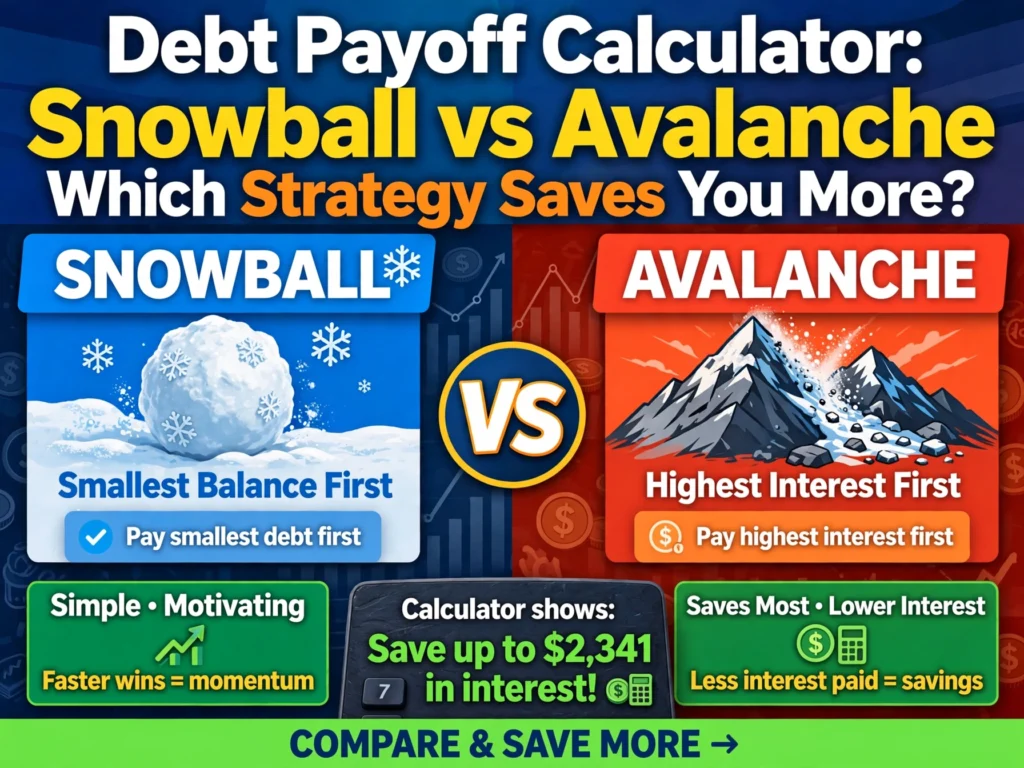
If money was purely a spreadsheet exercise with zero emotion involved, the Debt Avalanche would be the undisputed champion. The strategy is brutally logical: You list your debts from the highest interest rate to the lowest. You throw every spare penny at the debt with the highest APR while paying minimums on everything else.
Who is this for?
This method is for the analytical mind. It is for the person who gets a dopamine hit not from a reward now, but from knowing they mathematically paid the least amount of fees possible. If you are laser-focused and hate the idea of the bank making a dollar more off you than necessary, the Avalanche saves you the most money in the long run.
The Psychological Battle of High Interest
However, there is a catch. If your highest-interest debt is also a massive, soul-crushing balance (like a $30,000 credit card), attacking it first can feel like throwing pebbles at a fortress. You might not see progress for a year or more. This is why the calculator is essential here; it proves that your balance is dropping, even when it feels like you’re treading water.
4. The Snowball Method: The Psychology of Quick Wins
Now, let’s talk about the human spirit. Dave Ramsey popularized the Debt Snowball, but its roots are in behavioral psychology. With the Snowball, you ignore the interest rates and list your debts from the smallest balance to the largest. You attack the smallest debt like a hungry wolf until it’s dead.
Why Small Victories Matter More Than Math
Humans are emotional creatures. We are wired for gratification. When you pay off a small $500 medical bill or a tiny credit card in just one or two months, your brain releases a rush of relief and pride. You think, “I did that. I can do the next one.” This momentum is an incredibly powerful fuel. Even though you might pay slightly more in interest over time compared to the Avalanche, the Snowball drastically reduces the risk of you giving up entirely. Quitting is the most expensive thing you can do.
5. Head-to-Head: A Real-Life Example Using the Calculator
Let’s stop dealing in theories and look at a human scenario. Imagine you have four debts and an extra $500 a month to throw at them beyond the minimums.
- Credit Card A: $800 balance, 18% interest.
- Personal Loan: $5,000 balance, 10% interest.
- Credit Card B: $2,000 balance, 25% interest.
- Car Loan: $12,000 balance, 6% interest.
The Avalanche Path (Highest Interest First):
The calculator sorts these by the “price” of the money. You attack Credit Card B (25%) first, even though it’s not the smallest. This saves you the most in interest costs. It is the cheapest route to freedom, but it takes a few months to clear that first balance.
The Snowball Path (Smallest Balance First):
The calculator sorts by balance size. You attack Credit Card A ($800) first. In less than two months, it’s gone. You get that instant win. Then, you roll that payment into the next smallest—Credit Card B. The psychological “high” is immediate, keeping your motivation engine running hot.
6. The “Hybrid” Approach: When You Need a Custom Plan
Life is rarely black and white. Maybe your brain needs the mathematical efficiency of the Avalanche, but your heart needs the Snowball’s quick win to relieve immediate stress.
There is a third, unofficial path called the Hybrid Method. You use a calculator to Snowball just the very first, tiny debt to get a taste of victory. Once you have that confidence, you switch to an Avalanche strategy for the rest of the journey to save on interest. It’s like training wheels for debt freedom. You get the emotional jump-start without sacrificing too much long-term logic.
7. How to Use a Calculator to Stay Motivated Halfway Through
The middle of a debt-free journey is a dangerous desert. The initial excitement has worn off, but the finish line is still a blur on the horizon. This is where a calculator becomes a lifeline.
Don’t just look at the end date. Go back into the tool and play “what if.” What if you sold that old exercise bike for $100 and put it on the debt? How much earlier does your freedom date move? What if you negotiated a 1% lower interest rate? Click “recalculate.” Watching that timeline jump forward because of a small sacrifice you made is a massive emotional boost. It turns a boring process into a video game where you are leveling up.
8. The Final Verdict: Choosing the Debt Path You Can Walk
So, which one do you pick?
Run the numbers in a debt payoff calculator and look at the difference in the payoff date and total interest. If the dates are close (within a few months), choose the Snowball. The risk of losing motivation isn’t worth the minor savings.
If the calculator shows that the Avalanche will get you out of debt a full year (or more) earlier and save you thousands in interest, you need to dig deep and choose the Avalanche. But promise yourself you will celebrate the small milestones along the way, even if the balance sheet doesn’t say “zero” yet.
The tool isn’t there to judge you; it’s there to show you the exit. Whether you take the scenic route (Snowball) or the highway (Avalanche), the only wrong choice is staying stuck in the parking lot.
It’s time to stop letting numbers scare you. Open the calculator, face the screen, and take the first step toward breathing freely again. You’ve got this.